List with personal times and points!
🧬 Context
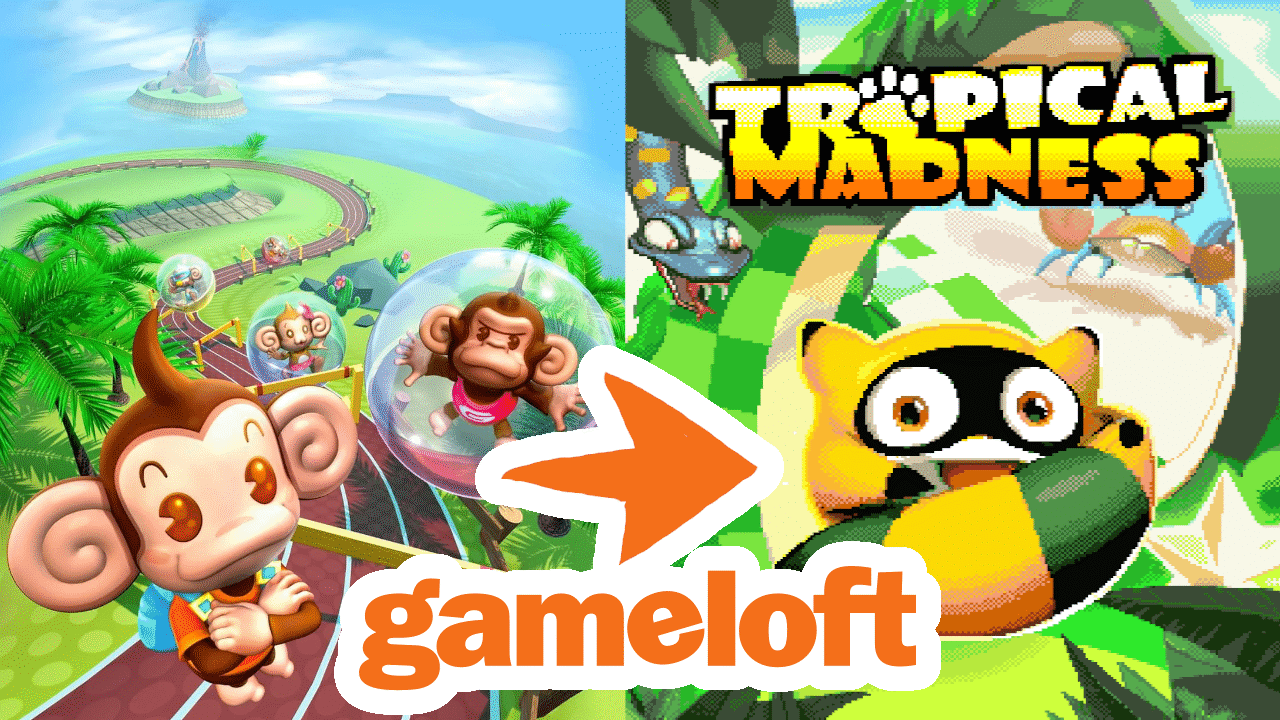
While following a channel dedicated to showcasing gameplay of rare games, Tropical Madness immediately caught my eye (thanks to the thumb). A quick look was enough to realize it was something akin to Super Monkey Ball, but with an isometric perspective. I was intrigued and genuinely surprised by how well-crafted its gameplay was, especially by the standards of mobile games.So, I decided to also read a review I’d stumbled upon via a search engine. After reading it, my excitement went into overdrive... right up until I discovered that the development of this game involved a name that was as highly renowned in the distant past as it has become infamously notorious of late.
Before Gameloft found itself relying solely on Asphalt (its primary cash cow - the company (originated as an offshoot of Ubisoft) focused largely on developing high-quality mobile games. This served as an ideal testing ground for creating original, eccentric titles with minimal budgets and very low risk, even while contending with the rigid constraints of the J2ME software standard.
Ready for this retroview? Let’s get started!
Gameplay
At its core, it’s a well-crafted blend of Marble Madness (the game’s structural foundation), Sonic 3D Blast (rolling, dashing, homing attacks and scripted boost-pads), DK Country (cannons) and Super Monkey Ball (I’ll leave it to you to figure out which aspect).Each level features a blocky and linear layout, with the excellent structural design making it clear where to go. There is no jumping mechanic (and its absence is never felt); instead, you progress using ramps, cannons, gliding, water currents, and so on.
The game makes it easier to avoid falling off ledges immediately (provided you aren't moving too fast), giving you a chance to head in the opposite direction; if you don't react in time, you'll fall and incur a penalty (which affects your final score)!
The bonus levels - though serving no real purpose, given the absence of an arcade mode or a lives system - function as endless run gimmick, where you can only shift from side to side to anticipate where the most stars are located and avoid obstacles.
Graphics
Featuring delightful and stylized pixel art - the likes of which many contemporary games could certainly use more - and an excellent grasp of depth of field (not a given in an isometric perspective), though there are some blue stars that leave you unsure whether they’re on the floor or hovering above it until you actually touch them.There isn’t a single element out of place in any of the worlds, and the attention to detail extends to the richness of the surrounding environment - making the world feel truly alive, even in low resolution and viewed through a screen. Furthermore, many elements do not repeat from one world to the next, which adds to the overall variety.
Sound
Quite catchy: though - and this is subjective - it would have been nice to have longer and looping level music, as the non-looping jingles don't really add enough to the gameplay experience. Of course, doing so would mean losing sound effects - a typical limitation of J2ME - but that’s a compromise one could live with.As for the sound effects, well... they’re about average. Very few, I’d say, but sufficient to complement the dynamic feel the game conveys. My favorite is the one that plays when you hit an enemy with a homing attack.
Controls
Alas, the most painful drawback: as with any J2ME game, the awkwardness of using a small keypad is compounded by the camera perspective (isometric) and the complexity of the controls (4 or 8 directions + action).The situation becomes more difficult when navigating particularly tricky and narrow passages, requiring delicate movements and precise braking to avoid falling off or being hit by an enemy. Better maneuverability can be achieved using an analog stick from a joypad (if the device supports it).
You can still play reasonably well, but don't expect to be reckless - especially in a game like this, where surgical precision in your movements makes a huge difference in achieving the best results; after all, you are controlling a "ball".
Replayability
Extremely high! There is no lives system, and there is a convenient, easy-to-grasp menu for selecting levels. You can play them at any difficulty level you choose, as they are all part of the same save file.Longevity
Very low! It features 3 worlds, each with 4 levels, for a total of 12: 9 main levels, 2 bonus levels, and 1 boss (final) level. There are no extra levels or worlds that can be unlocked through secondary means - you simply play through the game from start to finish, experiencing everything in a linear fashion.The average duration of each level ranges from 1 to 5–6 minutes, depending on the linear distance to be covered, wasted retries and the speed at which one progresses. For those with a few tricks up their sleeves, the whole thing can take about half an hour.
Accessibility'
Lacking: the control system can be changed, with three different configurations ranging from 4 to 8 directions; you can enable or disable hints (which suggest which controls to use to proceed), as well as music and sound effects. There is no colorblind mode.Difficulty
Controls aside (seriously, play it with a joypad), the difficulty ranges from easy to challenging (the 11th level, in particular). The high replayability also helps you memorize every single element of a level, allowing you to learn and improve your results. There is no dedicated high-score screen, so be prepared to take screenshots of the results screen at the end of each level.The "Hard" difficulty (unlocked upon completing the game on "Normal") doesn't offer any significant changes: the level structure remains virtually the same, though you lose more blue stars when taking damage, and the enemy placements (as well as the locations of a few stars) are subtly altered. Even the final boss doesn't feature a new attack pattern and no few extra flames. It would have been better if "Hard" mode had been available from the start and included mirrored levels.
In conclusion
As for a rating, I’d say this is a decent game: it does its job very well, though it could have been a bit more ambitious by offering some extra content. If there ever happens to be a Tropical Madness 2 in the future (I certainly hope so, even if the current Gameloft would never make it), I’ll definitely check it out.❤️ And to conclude... + 🗣️ Comment Section
Conceived, written and edited from 16·Nov·2026 to 18·Nov·2026; the photo-montage from and to 17·Nov·2026.Telegram: Ita. · Eng.
Mastodon: Ita. · Eng.
Bluesky · Ludomedia · Reddit
